 Alpaka Farm Croatia
Origin and history
Alpacas belong to the kingdom Animalia, phylum Chordata, subphylum Vertebrata, class Mammalia, order Artiodactyla, suborder Tylopoda, family Camelidae — New World camels of South America — genus Vicugna pacos. Alpacas are believed to be a cross between the vicuña (Vicugna vicugna) and the guanaco (Lama guanicoe).
There are also crosses between a male llama and a female alpaca, called Huarizo. The Huarizo's wool is nowhere near alpaca quality, yet some "breeders" try to pass it off and sell it as alpaca. More recently, crosses called Pacovicuña have appeared — alpaca–vicuña hybrids with improved wool quality and a higher wool yield per animal.
The domestication of alpacas began 3000 years before Christ, primarily for their fine wool and their very tasty, high-quality meat. Inca rulers measured power and wealth by the size of their alpaca herds. With the arrival of the Spanish in Peru, alpacas were nearly exterminated: the conquerors wanted to kill all domestic animals and impose their sheep on the pastures of the native species. The local people fled with their herds to higher regions of the Andes and managed to save the alpaca. After the independence of the South American states, more intensive breeding finally began and alpaca numbers grew again.
Appearance and wool
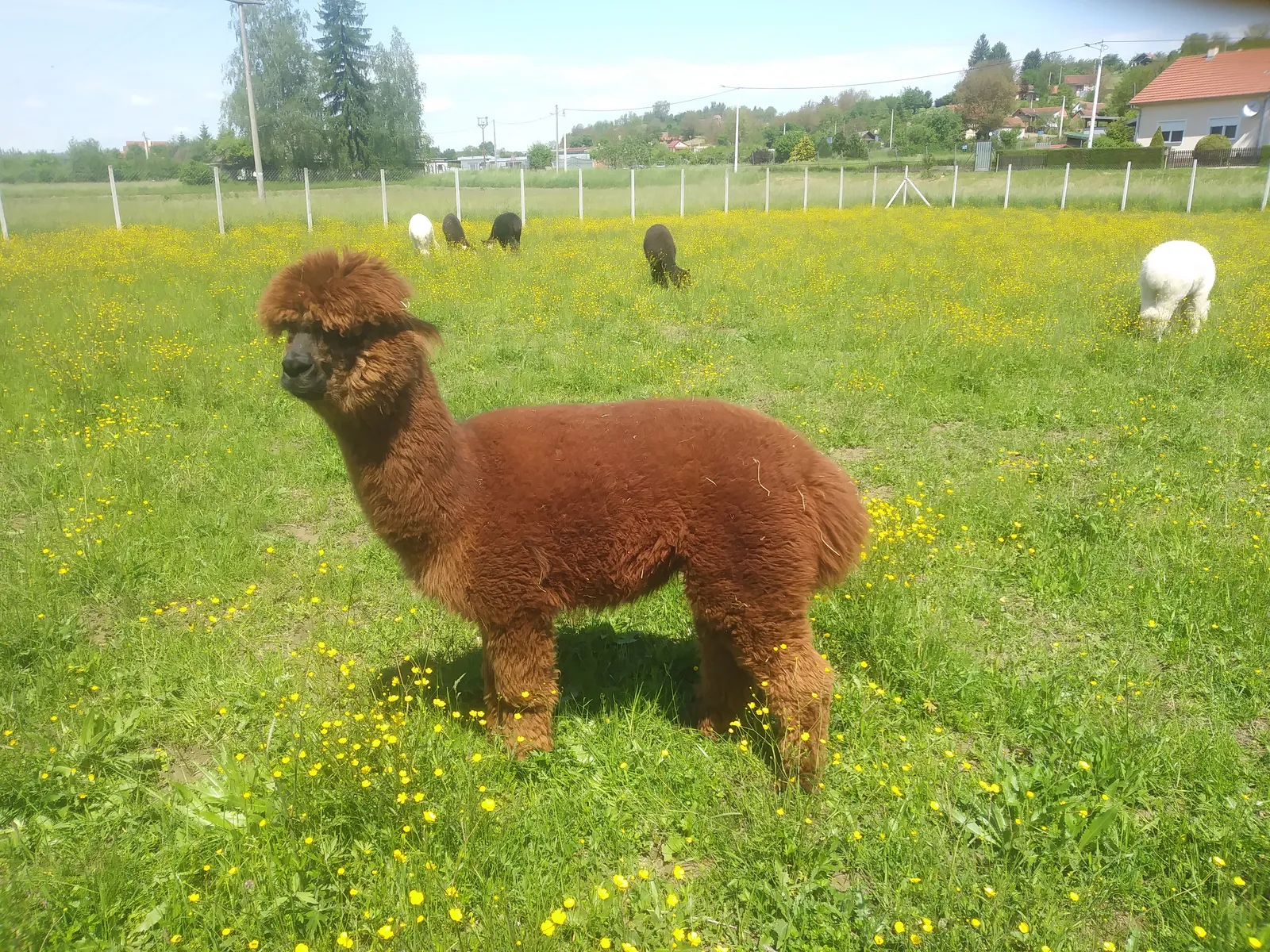
An alpaca stands 75–100 cm at the withers, 150–190 cm to the top of the head. Body weight ranges from 55 to 80 kg, while a newborn cria weighs 6.5–9 kg. They can run at up to 55 km/h and live 15–20 years. There are two breeds of alpaca: Huacaya and Suri.
Like other New World camels, alpacas have thin, long legs and a long, slender neck with a small head. They are generally smaller and lighter than llamas. Most are a single colour, while two-coloured animals fetch higher market prices. They naturally come in 22 different wool colours, and the fibre can grow up to 50 cm long. They are shorn once a year, and their wool can be made into every knitted and woven item that sheep's wool can.
Alpaca wool is the finest wool in the world — finer than merino wool and cashmere.
Behaviour and the herd
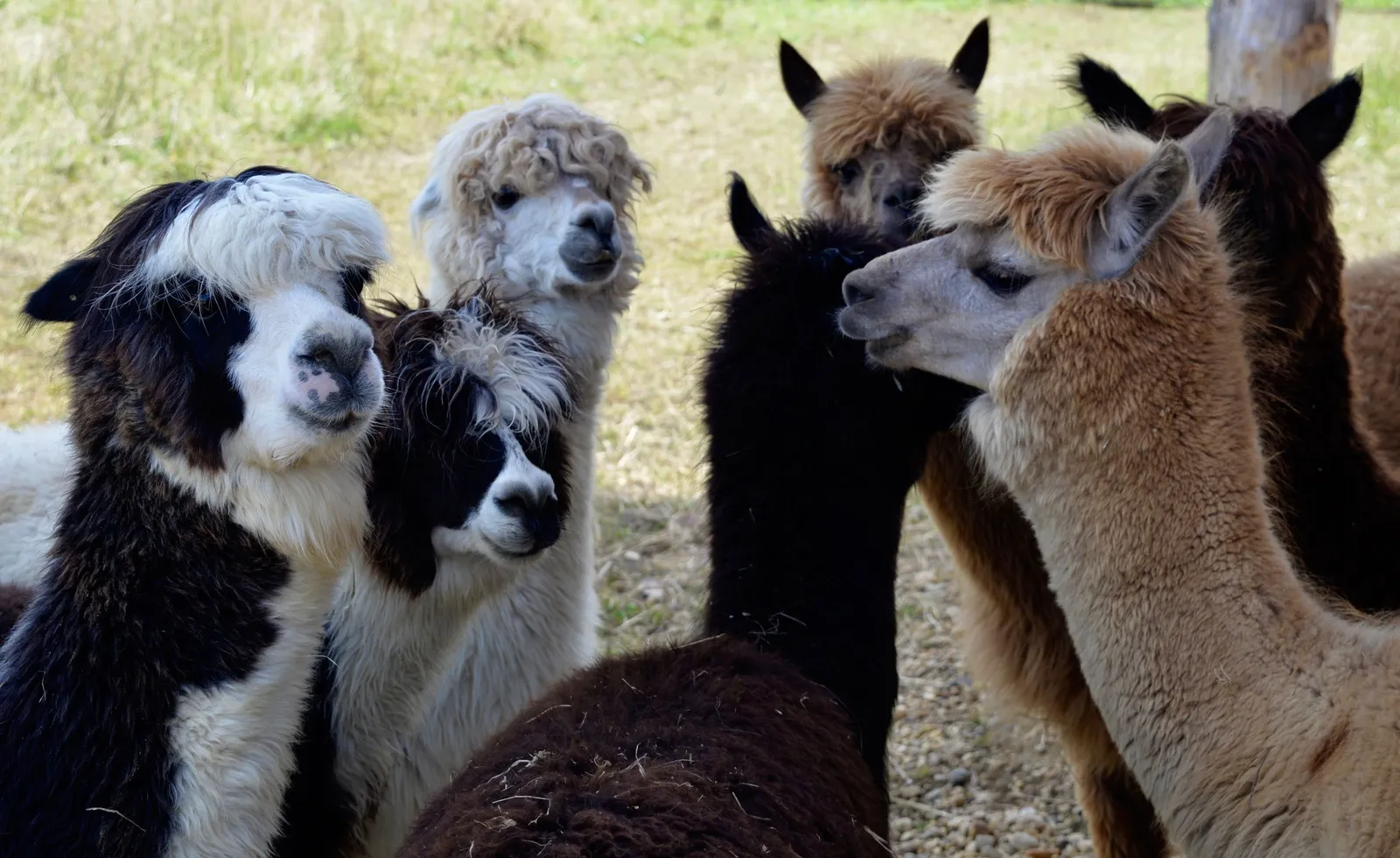
Alpacas are social animals, which means they are happiest in a herd. They are a polygamous species: one male keeps a harem of up to ten females. A male may be with the females only during the mating season; otherwise he must be kept apart from them, but always within sight of them.
Two or more males must never share a pasture or a stable, as they will inevitably and constantly injure each other. Every male must be kept apart from other males at all times — in a way that lets them see each other without being able to fight.
Alpacas are very tidy animals and relieve themselves in one fixed spot, both on the pasture and in the stable — provided you clean that spot daily. Their vocalisations are charming and very rare: when content, they mostly hum a quiet hmm hmm… The alpaca that first spots a danger lets out a shrill, high-frequency whistle to warn the rest of the herd. The herd then groups together, with the young in the middle, and confronts the threat.
Defence and temperament
Although they seem calm and timid, alpacas are explosive, energetic and quick. When attacking, at a distance of 2–3 metres they first rear up on their hind legs (standing over 2.5 metres tall) and charge: they strike with their chest and front legs, bite, and spit greenish-grey stomach acid with a range of 2–3 metres. If the acid hits an eye, the eye must be treated for three weeks with a special anti-inflammatory ointment, at least twice a day.
In defence they spit, leap a metre into the air and kick out with all four legs — their feet carry sharp nails that can tear a predator's skin — while springing 2–3 metres sideways and running on to a safe distance. Since they run at up to 55 km/h, forget about "herding" them with sheepdogs or livestock guardian dogs. If a dog tries to chase an alpaca, the alpaca will immediately spit at it, kick it and go at it with its front legs — and any sensible dog backs off. What's more, alpacas are fiercely territorial and tolerate no other species on their pasture.
Feeding
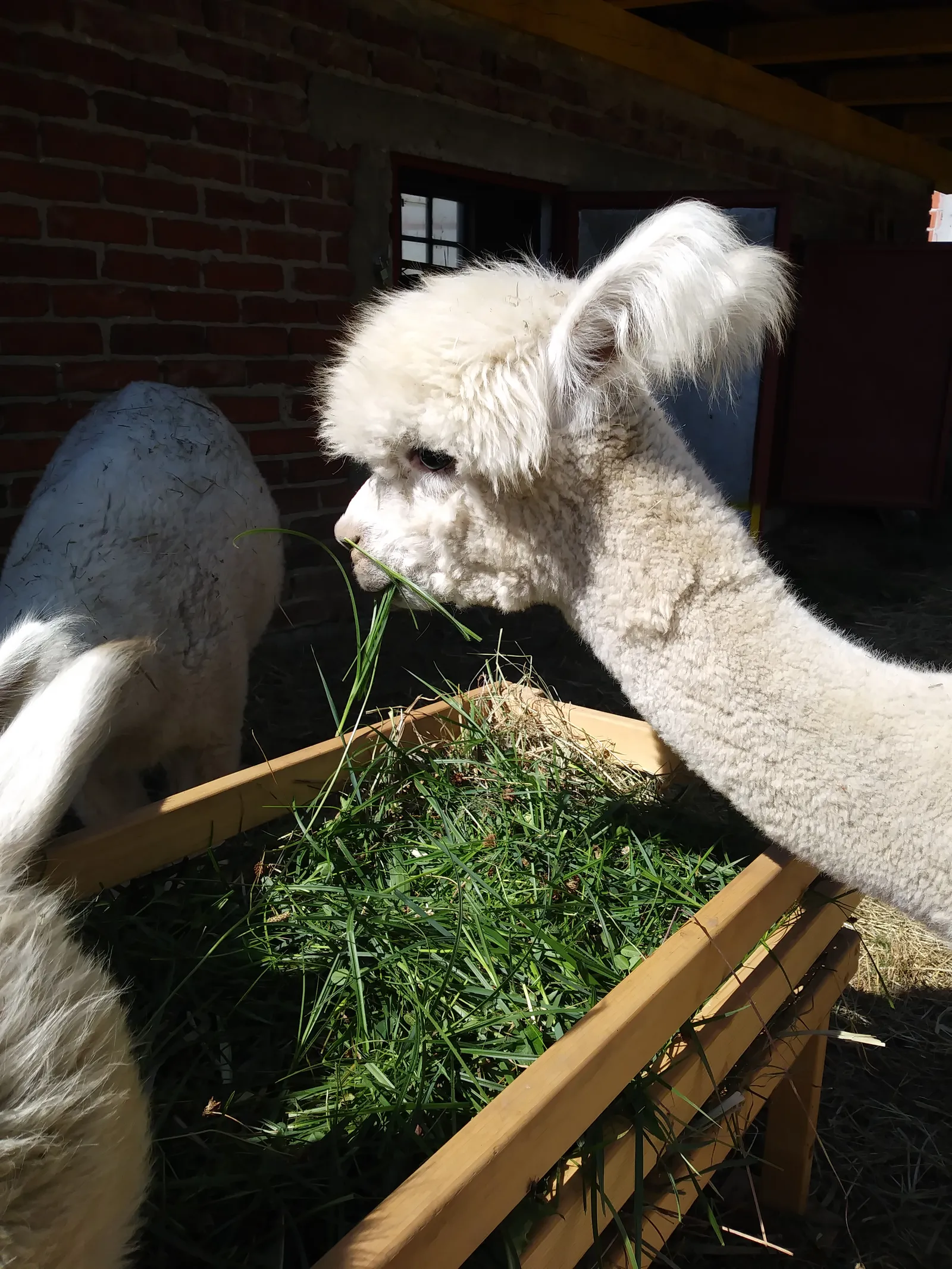
Alpacas are herbivores: they eat grasses and hay, plus special feed mixes blended exclusively for them. From hay they eat only the leaves, and the hay must be no longer than 30 centimetres. Like other camels they are not true ruminants (although they chew the cud), as they have a complex stomach that helps them digest and use their food better. They eat non-stop: at night they wake every 2 hours, eat, relieve themselves and go back to sleep. They mostly sleep with their eyes half open, only rarely falling fully asleep.
Breeding
Alpacas breed all year round, as the females can be continuously fertile. Pregnancy lasts 11–12 months, and the female always gives birth to a single cria — the Peruvian name for a baby alpaca. Within its first hour of life the cria must stand, walk and suckle its mother's colostrum.
Because the females produce very little milk, the cria must nurse every 1.5–2 hours, day and night, for the first 7–8 months. If the mother rejects the cria — and if you are lucky enough that it accepts a bottle — you will be the one bottle-feeding every hour and a half, day and night, for those first 7–8 months. If not, the cria will die. After a week or two the cria starts nibbling hay and grass, but milk remains its staple food; nursing continues until it is a year old.
Females reach sexual maturity at 2–3 years, while males rarely sire offspring before their third year, as they are not yet sexually mature.